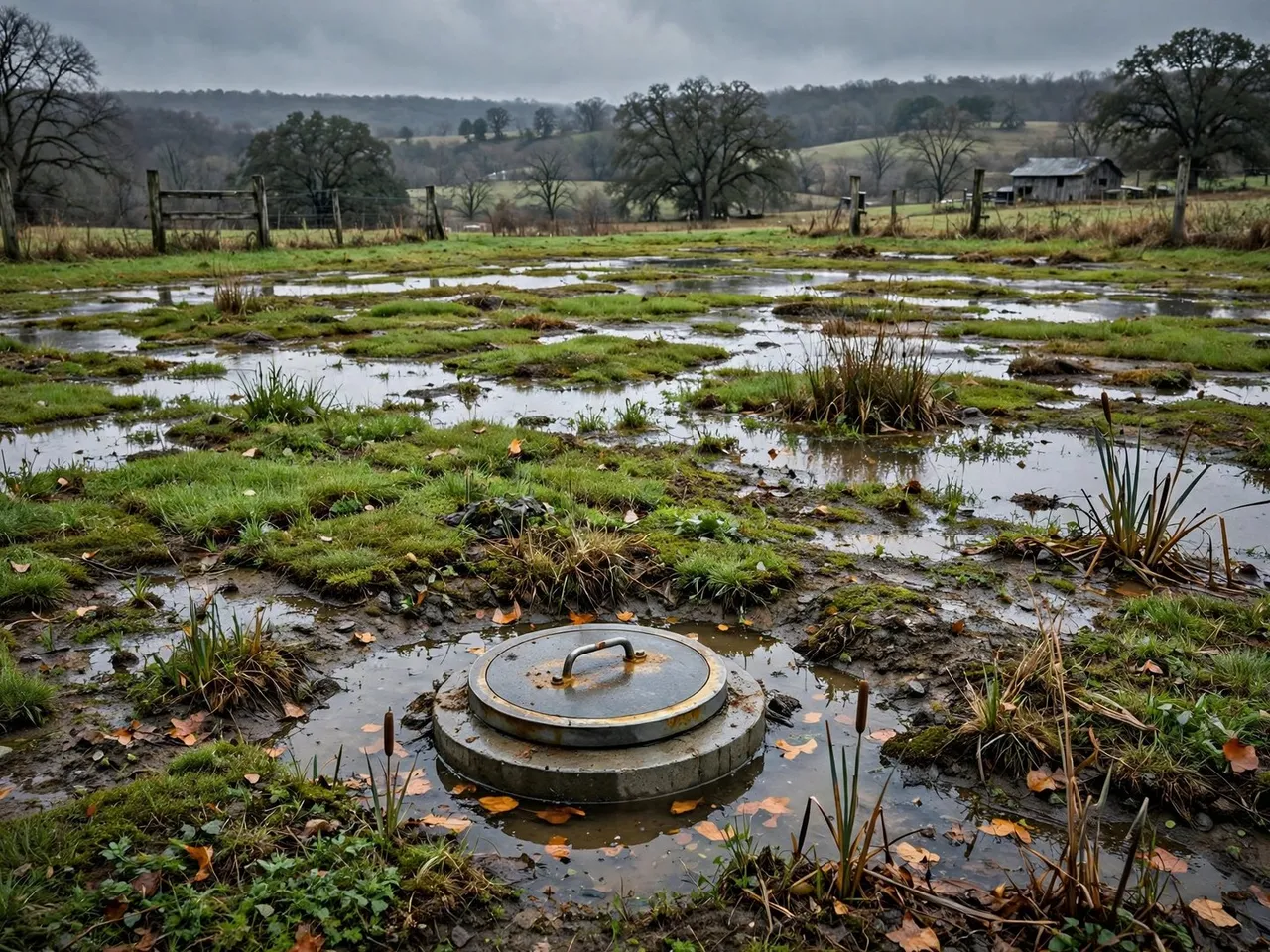
A drainfield fails slowly, then all at once. For months it absorbs a little less than it should, and the signs are easy to miss. Then a wet week, a full house, or a laundry day pushes it over the edge, and the system that looked fine on Monday is backing up on Friday. In Knox County, where most septic homes sit on large lots outside the KUB sewer area, a failed drainfield is the most expensive septic problem a homeowner faces, and the signs are worth knowing before they become an emergency.
The five signs to watch for
Slow drains throughout the house. One slow drain is a clog in that drain. Every drain running slow at once is a system problem, and the drainfield is the usual suspect. If the slowness comes and goes with heavy water use, that points at the field too: it can keep up with a quiet day and not with a busy one.
Sewage smells outside. A healthy system should not smell. Odours near the tank or over the drainfield mean wastewater is not being treated underground the way it should be, and is reaching the surface instead.
Wet or soggy areas over the drainfield. The ground over a working field should be no wetter than the rest of the yard. Standing water or soggy patches, especially when it has not rained, mean the soil is no longer absorbing.
Unusually lush grass over the field. Wastewater is fertiliser. A strip of grass over the drainfield that is greener, taller, or faster-growing than the rest of the lawn is feeding on effluent that should have stayed underground.
Sewage backing up into the house. This is not a warning sign, it is a failure. Stop using water, avoid contact with the sewage, and call a local emergency septic provider directly right away. Do not use the request form for an emergency: it is for non-emergency requests only and is not monitored continuously.
Why East Tennessee ground makes it worse
Knox County sits on karst, limestone with shallow bedrock in places, and that shapes what a drainfield can do. Where the soil is too thin for a conventional field, a lot needs a mound system instead, and a mound costs far more to build than a conventional field. Clay soils, common in East Tennessee, absorb treated water slowly, which makes a drainfield's remaining life harder to judge from the surface and easier to overload with a sudden jump in water use.
The commonest cause of failure is also the simplest: a tank left too long between pumpings, so solids carry over and clog the field soil. A tank should be pumped every 3–5 years with ordinary use, and every 2–3 years if the house uses a garbage disposal. Other causes include tree roots, heavy vehicles driven over the field, and a system sized for a smaller household than the one using it now. Our guide to septic pumping costs in Knoxville covers the pumping schedule that exists to prevent this bill.
What happens next: diagnosis, then a decision
A failed field cannot be priced over the phone. Repair work starts with an on-site assessment, because a clogged line or a failed distribution box can sometimes be fixed, while a field whose soil is clogged with solids usually cannot be repaired at all: it has to be replaced. No generic repair price is published locally, and providers give a free on-site estimate. Be wary of any price given without a visit.
If replacement is needed, the numbers are significant. As guidance only, drainfield replacement in East Tennessee typically runs $5,000–$15,000 for a conventional field or $15,000–$30,000 for a mound field, and a complete new system typically runs $12,000–$35,000 depending on the type. Every repair needs a permit from the Knox County Health Department before work starts, and a repair permit itself costs nothing.
Help with the bill
One cost that surprises people: Knox County's Stormwater Management grant programme may pay up to 75 percent of the cost of septic repairs or a sewer connection, where available. The county directs the process, starting with a call to Stormwater at (865) 215-5800 and a Health Department inspection and permit, and it selects the contractor from three bids. Our guide to the Knox County septic repair grant explains who qualifies and how to apply.
If you have spotted one of the signs above, do not wait for a second one. A field that is struggling can sometimes be saved by pumping the tank and cutting water use; a field that has failed outright is a replacement. The difference between those two outcomes is often a matter of weeks.
Worried about your drainfield? Ask about septic repair in Knoxville — a local septic professional will get in touch, usually within an hour between 7am and 8pm Eastern.
Septic Repair and Drainfield Repair in Knoxville, TN