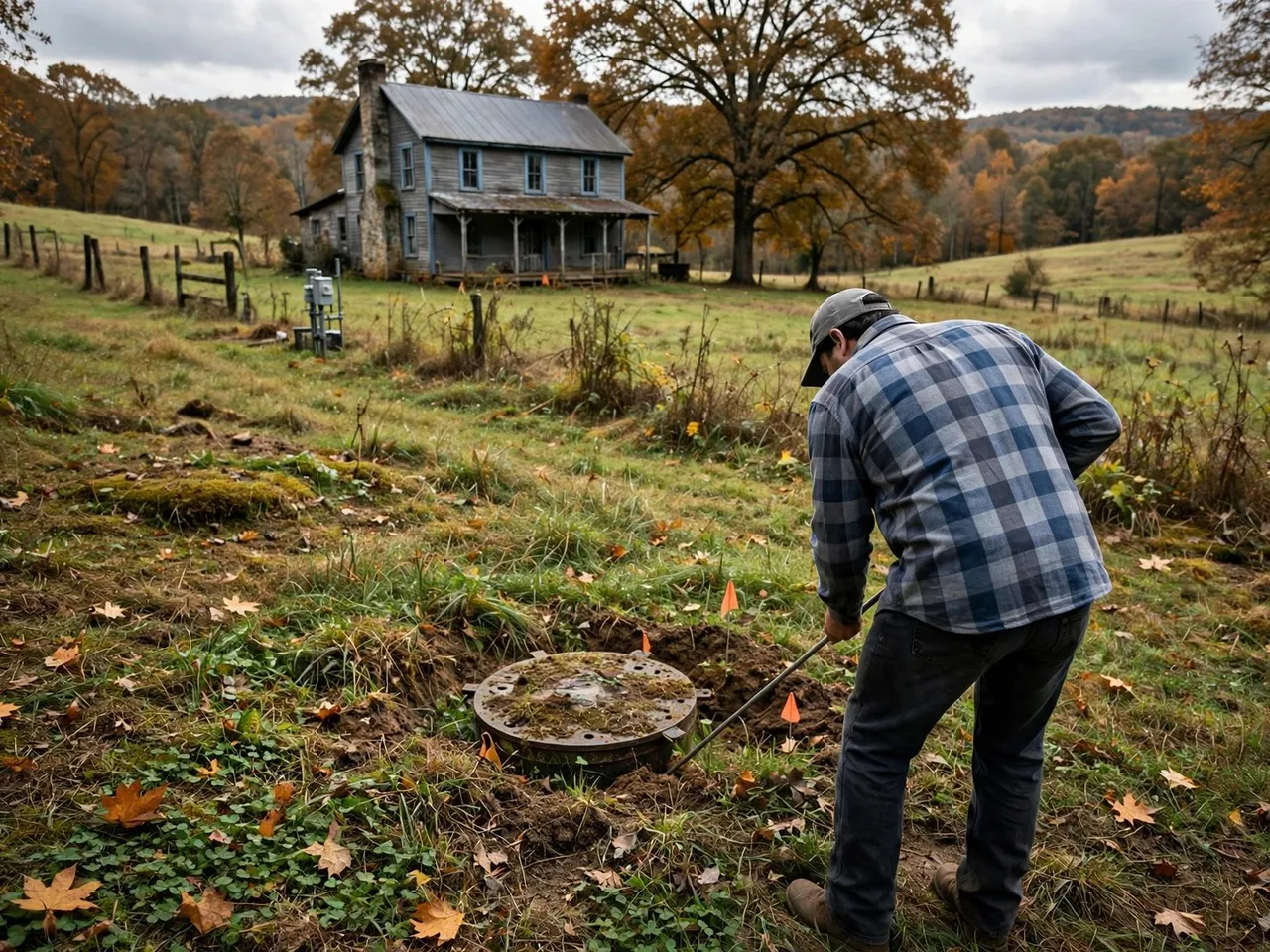
Most septic tanks in Knox County are buried, and a surprising number of homeowners do not know exactly where theirs is. That becomes a problem the first time the tank needs pumping, the first time a drain backs up, or the first time a buyer asks where the system sits. Finding it is usually straightforward, and it is worth doing before you need it in a hurry. These are the steps, in the order that wastes the least time. One rule runs through all of them: never enter or open a septic tank yourself. The gases inside can be lethal.
Start with the county records
The cheapest step is a paper one. The Knox County Health Department's Groundwater Protection Division can provide available records on an existing septic system through a file search request. Those records can reveal the system type, a layout or soil map, and previous repair work, and a layout will often show the tank's position relative to the house. The division can be reached at (865) 215-5200, extension 1.
Be realistic about what the records hold. A system installed in the last twenty years is likely to have a useful file. An older system may have thin records, or none at all. If the county has nothing, the next steps still work. If the county has a layout, the rest of this guide takes ten minutes.
Follow the sewer line out of the house
A septic tank sits on the line of the main sewer pipe leaving the house, usually 10 to 25 feet from the foundation, though older installations can be further out. Find where the main drain leaves the house, usually in the basement or crawl space, or where the cleanout sits outside, and follow that line in a straight path away from the house. The tank is on that line.
Look for clues in the yard as well. A rectangular patch of grass that is greener, or that dries out differently from the rest of the lawn, can mark the tank or the drainfield. A slight depression, a patch of bare earth, or a concrete or metal lid just below the surface all point the same way. In winter, snow melts first over a tank and a drainfield, because both are warmer than the surrounding ground. None of these is proof on its own, but together they narrow the search to a few square yards.
Probe for the lid
Once you have a likely area, probe it. A thin metal rod, pushed gently into the ground every foot or so, will hit something solid over the tank lid and sink easily everywhere else. Work in a grid across the likely area, and mark each hit. The lid is usually a concrete or fibreglass rectangle, and once you have found two or three solid hits in a row, you have found its edge.
Dig carefully by hand once you are confident, and stop at the lid. Do not lift it, do not climb into the tank, and do not let children near an open tank. If the lid is buried deep, note the depth: a provider can fit a riser, a pipe that brings the lid up to the surface, so the next pumping does not need digging at all. Digging to expose a buried lid is usually charged extra on a pumping visit, so knowing the depth before you book saves a surprise on the bill. Our guide to septic pumping costs in Knoxville explains what a visit includes and what it typically costs.
When to call a professional
Call a professional if the county has no records and probing finds nothing, if the ground is rocky and the rod will not penetrate, or if the system may be a mound system, where the tank and field layout is less obvious. A provider has electronic locators and, more importantly, experience with the systems in your part of the county. In Gibbs, Corryton, Mascot, and Strawberry Plains, where every home is on septic and the lots are large, a provider who works the area will usually find a tank faster than a homeowner with a rod.
Finding the tank is also the right moment to sort out the paperwork. If you are buying the house, ask the county for its records and consider the Health Department's $200 Verification, which reviews the county's files and sends an environmentalist to confirm the system is working and that there is room to repair it. Our guide to septic inspection when buying a house in Knoxville covers what else to check before you close.
Found your tank and need it pumped? Ask about septic tank pumping in Knoxville — a local septic professional will get in touch, usually within an hour between 7am and 8pm Eastern.
Septic Tank Pumping in Knoxville, TN